Legenda Bookstore
HOME
ACCOUNT
GIFT CARDS
WISHLIST
SHOP

From the River to the Sea

By Samer Abu Hawwash

13.00 JOD

[cool_tag_cloud taxonomy="product_tag" smallest="16" largest="16" on_single_display="local"]
Add to Wishlist
Add to Wishlist
ISBN: 9781913043506
Publisher: Banipal Publishing
Binding: Paperback
Number of Pages: 96
Publication Date: 21 Jul 2025
Share on

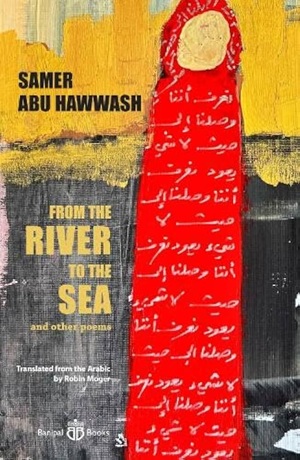
This new collection by Palestinian poet Samer Abu Hawwash was published in its original Arabic in the summer of 2024. The 24 poems are an intrepid literary journey into the genocide in Gaza, linking with Palestine’s long years of existential trauma, and documenting the universal human questions that so many are asking in today’s world. Living, as he has done since being born in Lebanon in 1972, in a diaspora crowded with fellow Palestinians, the poet shares with readers the depths of his turmoil and anguish, searing their attention to human pain from the first poem, “The Ruins”, with the image of a girl’s hand jutting up from cracks in the rubble, to the last, “The Scream” – the roaring voice of dust consuming all. In the poem, “Sitting in front of a TV screen, I watch the genocide”, the words he wants to say are torn from him, they’re not able to express what he wants to say; “language has become a torment”; senses are upturned, stupified, suspended, muffled, in a maze. How to possibly describe the deadly scenes, surreal visions, the revelations, nightmares, sounds, one after the other, except by reliving them? And thus the poet brings to his poems what one critic has called a “dictionary of war”, a lexicon that expresses a graphic poetic sensibility set in the midst of a war that is exterminating a people. Alongside the lexicon, a way of “seeing” anew the unspeakable horrors through the gazes, the glances, the closed, open, dead eyes of famished families, of fragmented little corpses, children whose gazes are frozen, stunned, dead, scornful, fixed, dazed. And each glance, each look, each stare is integral to the entirety of the tiny elements making up the lives and breaths of Palestine. This is a poetry collection so necessary for humanity today, in a perceptive and passionate translation by Robin Moger.
Samer Abu Hawwash is a Palestinian poet, writer and translator, born in Sidon, Lebanon, in 1972. He started publishing his works in Lebanese magazines and newspapers in 1991, and in 1996 graduated in Journalism and Communication from the Lebanese University. His first poetry collection, "Life is Printed in New York", was published in 1997 and his most recent, "From the River to the Sea", in 2024. His nine other poetry collections include "This Is Not How Pizza Is Made", "I Will Kill You", "Death", "Last Selfie with a Dying World" and "Ruins". He also has three fiction works, "The Journal of Photographed Niceties", "Valentine’s Day" and "Happiness or a Series of Explosions that Shook the Capital". From 2004 he lived and worked in the United Arab Emirates, translating and editing American poetry and English-language fiction, and currently resides in Barcelona, Spain. He started his project translating American poetry in 1995 and has translated into Arabic works by over twenty American poets, including Charles Bukowski, Langston Hughes, Kim Addonizio, Robert Bly, Billy Collins and Charles Simic. He has also translated over forty prose works by major internationally renowned writers, including Jack Kerouac’s "On the Road", Yann Martel’s "Life of Pi", and "The Invention of Solitude", "Travels in the Scriptorium" and "Sunset Park" by Paul Auster. In 2009, he was one of 39 Arab authors chosen for the Beirut39 project, which took place in 2009-2010 when Beirut was the Arab World Book Capital. In 2024, he was awarded the Sargon Boulus Prize for poetry and translation.

Tab Content

This is a basic text element.

About Author

Samer Abu Hawwash is a Palestinian poet, writer and translator, born in Sidon, Lebanon, in 1972. He started publishing his works in Lebanese magazines and newspapers in 1991, and in 1996 graduated in Journalism and Communication from the Lebanese University. His first poetry collection, "Life is Printed in New York", was published in 1997 and his most recent, "From the River to the Sea", in 2024. His nine other poetry collections include "This Is Not How Pizza Is Made", "I Will Kill You", "Death", "Last Selfie with a Dying World" and "Ruins". He also has three fiction works, "The Journal of Photographed Niceties", "Valentine’s Day" and "Happiness or a Series of Explosions that Shook the Capital". From 2004 he lived and worked in the United Arab Emirates, translating and editing American poetry and English-language fiction, and currently resides in Barcelona, Spain. He started his project translating American poetry in 1995 and has translated into Arabic works by over twenty American poets, including Charles Bukowski, Langston Hughes, Kim Addonizio, Robert Bly, Billy Collins and Charles Simic. He has also translated over forty prose works by major internationally renowned writers, including Jack Kerouac’s "On the Road", Yann Martel’s "Life of Pi", and "The Invention of Solitude", "Travels in the Scriptorium" and "Sunset Park" by Paul Auster. In 2009, he was one of 39 Arab authors chosen for the Beirut39 project, which took place in 2009-2010 when Beirut was the Arab World Book Capital. In 2024, he was awarded the Sargon Boulus Prize for poetry and translation.

Description

This new collection by Palestinian poet Samer Abu Hawwash was published in its original Arabic in the summer of 2024. The 24 poems are an intrepid literary journey into the genocide in Gaza, linking with Palestine’s long years of existential trauma, and documenting the universal human questions that so many are asking in today’s world. Living, as he has done since being born in Lebanon in 1972, in a diaspora crowded with fellow Palestinians, the poet shares with readers the depths of his turmoil and anguish, searing their attention to human pain from the first poem, “The Ruins”, with the image of a girl’s hand jutting up from cracks in the rubble, to the last, “The Scream” – the roaring voice of dust consuming all. In the poem, “Sitting in front of a TV screen, I watch the genocide”, the words he wants to say are torn from him, they’re not able to express what he wants to say; “language has become a torment”; senses are upturned, stupified, suspended, muffled, in a maze. How to possibly describe the deadly scenes, surreal visions, the revelations, nightmares, sounds, one after the other, except by reliving them? And thus the poet brings to his poems what one critic has called a “dictionary of war”, a lexicon that expresses a graphic poetic sensibility set in the midst of a war that is exterminating a people. Alongside the lexicon, a way of “seeing” anew the unspeakable horrors through the gazes, the glances, the closed, open, dead eyes of famished families, of fragmented little corpses, children whose gazes are frozen, stunned, dead, scornful, fixed, dazed. And each glance, each look, each stare is integral to the entirety of the tiny elements making up the lives and breaths of Palestine. This is a poetry collection so necessary for humanity today, in a perceptive and passionate translation by Robin Moger.

Tab Content

This is a basic text element.
Add a review
From the River to the Sea From the River to the Sea
Rating*
0/5
* Rating is required
Your review
* Review is required
Name
* Name is required
Add photos or video to your review
0.0
Based on 0 reviews
5 star
0%
4 star
0%
3 star
0%
2 star
0%
1 star
0%
0 of 0 reviews

Sorry, no reviews match your current selections

You Might Also Like

©2026 Legenda Bookstore. All Rights Reserved.
Powered by UAE Grid
Accepted payment methods - COD and Visa
0