Legenda Bookstore
HOME
ACCOUNT
GIFT CARDS
WISHLIST
SHOP

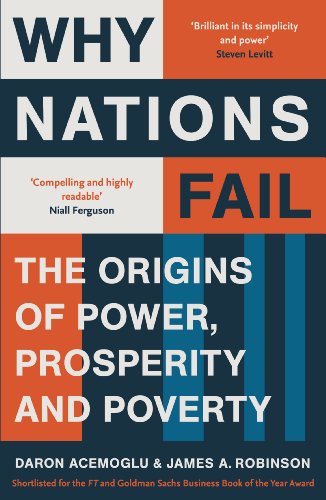
Why Nations Fail: The Origins of Power, Prosperity and Poverty

By Daron Acemoglu, James A. Robinson

15.00 JOD

Add to Wishlist
Add to Wishlist
ISBN: 9781846684302
Publisher: Profile Books Ltd
Binding: Paperback
Number of Pages: 544
Publication Date: 21-Mar-13
Share on

Brilliant and engagingly written, Why Nations Fail answers the question that has stumped the experts for centuries: Why are some nations rich and others poor, divided by wealth and poverty, health and sickness, food and famine?

Is it culture, the weather, geography? Perhaps ignorance of what the right policies are?

Simply, no. None of these factors is either definitive or destiny. Otherwise, how to explain why Botswana has become one of the fastest growing countries in the world, while other African nations, such as Zimbabwe, the Congo, and Sierra Leone, are mired in poverty and violence?

Daron Acemoglu and James Robinson conclusively show that it is man-made political and economic institutions that underlie economic success (or lack of it). Korea, to take just one of their fascinating examples, is a remarkably homogeneous nation, yet the people of North Korea are among the poorest on earth while their brothers and sisters in South Korea are among the richest. The south forged a society that created incentives, rewarded innovation, and allowed everyone to participate in economic opportunities. The economic success thus spurred was sustained because the government became accountable and responsive to citizens and the great mass of people. Sadly, the people of the north have endured decades of famine, political repression, and very different economic institutions – with no end in sight. The differences between the Koreas is due to the politics that created these completely different institutional trajectories.

Based on 15 years of original research Acemoglu and Robinson marshall extraordinary historical evidence from the Roman Empire, the Mayan city-states, medieval Venice, the Soviet Union, Latin America, England, Europe, the United States, and Africa to build a new theory of political economy with great relevance for the big questions of today, including:

  • China has built an authoritarian growth machine. Will it continue to grow at such high speed and overwhelm the West?
  • Are America’s best days behind it? Are we moving from a virtuous circle in which efforts by elites to aggrandize power are resisted to a vicious one that enriches and empowers a small minority?
  • What is the most effective way to help move billions of people from the rut of poverty to prosperity? More philanthropy from the wealthy nations of the West? Or learning the hard-won lessons of Acemoglu and Robinson’s breakthrough ideas on the interplay between inclusive political and economic institutions?

Why Nations Fail will change the way you look at—and understand—the world.

Daron Acemoglu is the Killian Professor of Economics at MIT and recipient of the prestigious John Bates Clark Medal. James A. Robinson is a political scientist and economist and the David Florence Professor of Government at Harvard University, and a world-renowned expert on Latin America and Africa. They are the authors of Economic Origins of Dictatorship and Democracy, which won numerous prizes.

Tab Content

This is a basic text element.

About Author

Daron Acemoglu is the Killian Professor of Economics at MIT and recipient of the prestigious John Bates Clark Medal. James A. Robinson is a political scientist and economist and the David Florence Professor of Government at Harvard University, and a world-renowned expert on Latin America and Africa. They are the authors of Economic Origins of Dictatorship and Democracy, which won numerous prizes.

Description

Brilliant and engagingly written, Why Nations Fail answers the question that has stumped the experts for centuries: Why are some nations rich and others poor, divided by wealth and poverty, health and sickness, food and famine? Is it culture, the weather, geography? Perhaps ignorance of what the right policies are? Simply, no. None of these factors is either definitive or destiny. Otherwise, how to explain why Botswana has become one of the fastest growing countries in the world, while other African nations, such as Zimbabwe, the Congo, and Sierra Leone, are mired in poverty and violence? Daron Acemoglu and James Robinson conclusively show that it is man-made political and economic institutions that underlie economic success (or lack of it). Korea, to take just one of their fascinating examples, is a remarkably homogeneous nation, yet the people of North Korea are among the poorest on earth while their brothers and sisters in South Korea are among the richest. The south forged a society that created incentives, rewarded innovation, and allowed everyone to participate in economic opportunities. The economic success thus spurred was sustained because the government became accountable and responsive to citizens and the great mass of people. Sadly, the people of the north have endured decades of famine, political repression, and very different economic institutions - with no end in sight. The differences between the Koreas is due to the politics that created these completely different institutional trajectories. Based on 15 years of original research Acemoglu and Robinson marshall extraordinary historical evidence from the Roman Empire, the Mayan city-states, medieval Venice, the Soviet Union, Latin America, England, Europe, the United States, and Africa to build a new theory of political economy with great relevance for the big questions of today, including:
  • China has built an authoritarian growth machine. Will it continue to grow at such high speed and overwhelm the West?
  • Are America’s best days behind it? Are we moving from a virtuous circle in which efforts by elites to aggrandize power are resisted to a vicious one that enriches and empowers a small minority?
  • What is the most effective way to help move billions of people from the rut of poverty to prosperity? More philanthropy from the wealthy nations of the West? Or learning the hard-won lessons of Acemoglu and Robinson’s breakthrough ideas on the interplay between inclusive political and economic institutions?
Why Nations Fail will change the way you look at—and understand—the world.

Tab Content

This is a basic text element.
Add a review
Why Nations Fail: The Origins of Power, Prosperity and Poverty Why Nations Fail: The Origins of Power, Prosperity and Poverty
Rating*
0/5
* Rating is required
Your review
* Review is required
Name
* Name is required
Add photos or video to your review
0.0
Based on 0 reviews
5 star
0%
4 star
0%
3 star
0%
2 star
0%
1 star
0%
0 of 0 reviews

Sorry, no reviews match your current selections

You Might Also Like

©2026 Legenda Bookstore. All Rights Reserved.
Powered by UAE Grid
Accepted payment methods - COD and Visa
0